New Content Alerts
Not a CPA Member? Sign up to receive a notification when new issues are available online.
Psynopsis accepts submissions of 400-900 words relevant to the theme or appropriate for one of our regular columns (i.e. Psychology in the Spotlight, Campus Profile, etc.). Please see our editorial guidelines for further information.
In an effort to publish a breadth of articles and avoid duplication of topic area, before making your submission, please contact Managing Editor, Sherene Chen-See at psynopsis@cpa.ca to discuss the content of your intended submission.
| Call for Submissions: Psynopsis Special Issue on Aging |
We have reached the mid-point of the United Nation’s Decade of Healthy Aging. As of 2019, the global population of adults over the age of 65 years exceeded that of children below the age of 5 years. Within the next five years, 20-25% of the North American population, and one in six people worldwide, is expected to be 65 or older. At the same time, since 2000, the burden of illness related to chronic illnesses, such as diabetes or Alzheimer’s disease, has more than doubled. This unprecedented growth in the older adult population, in the context of an increased burden of chronic illness and healthcare costs, necessitates an increased focus on strategies to enhance psychological well-being and optimize quality of life with ageing. Limited access to specialized mental health care practitioners, especially within the public healthcare system, challenges us to develop innovative and accessible Geropsychology services for older adults who often present with complex needs.
The upcoming issue of Psynopsis will focus on Aging. We are requesting brief submissions from students and psychologists highlighting the contributions of the Psychological Sciences in addressing important research questions on ageing as well as innovative psychological services for healthy older adults, those coping with chronic illness including cognitive decline, and/or approaching the end of life. Brief submissions addressing advocacy and health service policy considerations are also welcome.
- Submission deadline: November 30, 2026
|
Psynopsis
2026
2025
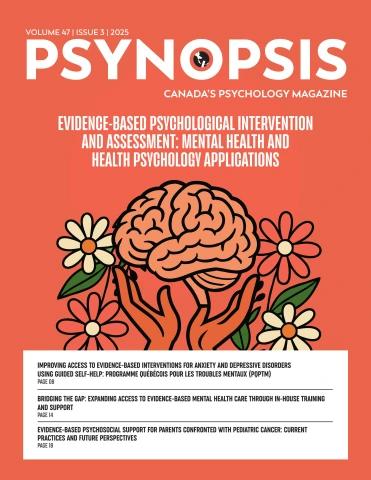
 Issue 3 2025
(
PDF &
References)
Vol. 47, No. 3
Evidence-based Psychological Intervention And Assessment: Mental Health and Health Psychology Applications
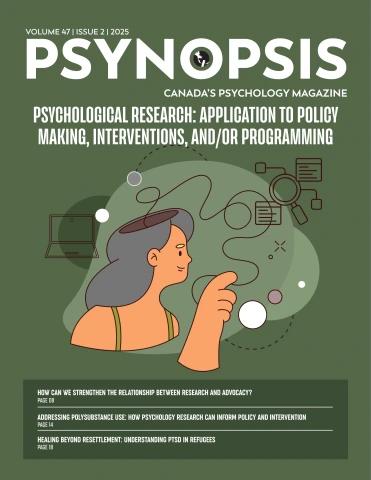
Issue 2 2025
(
PDF &
References)
Vol. 47, No. 2
Psychological Research: Application to Policy Making, Interventions, and/or Programming
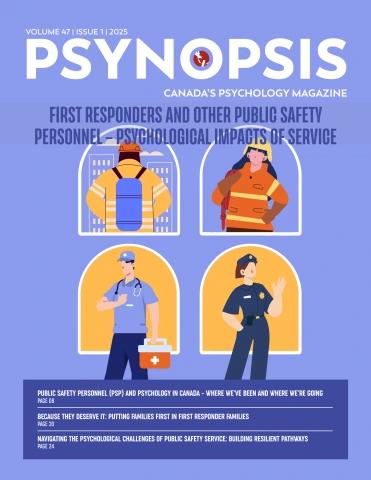
Issue 1 2025
(
PDF &
References)
Vol. 47, No. 1
First Responders and Other Public Safety Personnel – Psychological impacts of Service
2024
2023
2022
2021
2020
Issue 1 2020
(
PDF &
References)
Vol. 42, No. 1
The role of Psychologists in autism-related policy and practice in Canada
2019
Issue 4 2019
(
PDF &
References)
Vol. 41, No. 4
What is needed and what is next for Canada’s research community?
Issue 3 2019
(
PDF &
References)
Vol. 41, No. 3
Indigenous Peoples mental health and wellbeing: Updates in Canadian psychology practice
Issue 2 2019
(
PDF &
References)
Vol. 41, No. 2
Classification of mental disorders
Issue 1 2019
(
PDF &
References)
Vol. 41, No. 1
Professional psychology training
2018
Issue 4 2018
(
PDF &
References)
Vol. 40, No. 4
Refugee Mental Health
Issue 3 2018
(
PDF &
References)
Vol. 40, No. 3
Connecting Science to Solutions
Issue 2 2018
(
PDF)
Vol. 40, No. 2
The role of psychology in mitigating Canada’s opioid crisis
Issue 1 2018
(
PDF &
References)
Vol. 40, No. 1
Criminal justice psychology
2017
Fall 2017
(
PDF &
References)
Vol. 39, No. 4
Cannabis legalization
Summer 2017
(
PDF &
References)
Vol. 39, No. 3
Disability in Canada: The Role for psychologists
Spring 2017
(
PDF &
References)
Vol. 39, No. 2
Advocacy: a Job for all of Us
Winter 2017
(
PDF &
References)
Vol. 39, No. 1
The Role of Psychology in the “Concussion Crisis”
2016
Fall 2016
(
PDF &
References)
Vol. 38, No. 4
Medical Assistance in Dying: The Role of Psychology
Summer 2016
(
PDF)
Vol. 38, No. 3
National convention and much more – The value of the CPA
Spring 2016
(
PDF &
References)
Vol. 38, No. 2
Recovery and Recovery-Oriented Guidelines
Winter 2016
(
PDF &
References)
Vol. 38, No. 1
Mental Health, Homelessness, and Housing
2015
Fall 2015
(
PDF &
References)
Vol. 37, No. 4
Psychology and the Workplace
Summer 2015
(
PDF &
References)
Vol. 37, No. 3
Understanding Suicide
Spring 2015
(
PDF &
References)
Vol. 37, No. 2
Crisis Response/First Responders
2014
Fall 2014
(
PDF &
References)
Vol. 36, No. 4
Public Health and Health Promotion
Summer 2014
(
PDF &
References)
Vol. 36, No. 3
Diversity in the science and practice of psychology
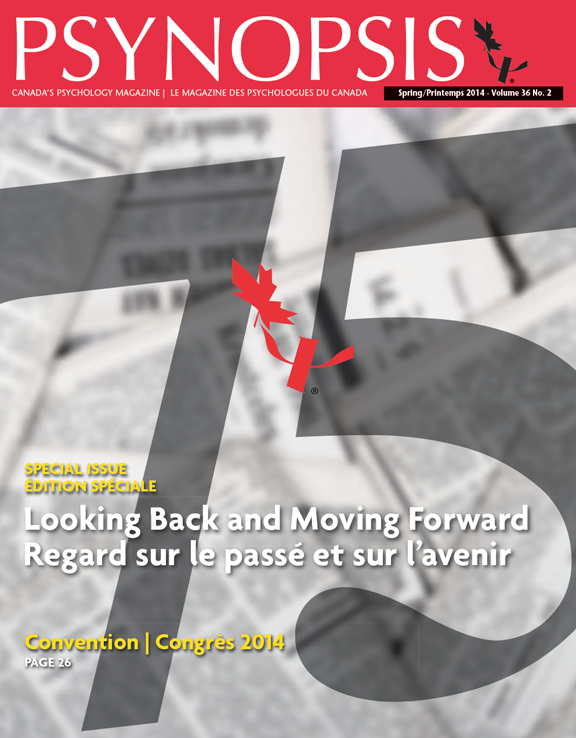
Spring 2014
(
PDF &
References)
Vol. 36, No. 2
Looking Back and Moving Forward
Winter 2014
(
PDF &
References)
Vol. 36, No. 1
Criminal Justice and Mental Health
|
2013
Fall 2013 (PDF & References) – Vol. 35, No. 4
Summer 2013 (PDF & References) – Vol. 35, No. 3
Spring 2013 (PDF & References) – Vol. 35, No. 2
Winter 2013 (PDF & References) – Vol. 35, No. 1 |
2012
Fall 2012 (PDF & References) – Vol. 34, No. 4
Summer 2012 (PDF) – Vol. 34, No. 3
Spring 2012 (PDF) – Vol. 34, No. 2
Winter 2012 (PDF) – Vol. 34, No. 1 |
|
2011
Fall 2011 (PDF) – Vol. 33, No. 4
Summer 2011 (PDF) – Vol. 33, No. 3
Spring 2011 (PDF) – Vol. 33, No. 2
Winter 2011 (PDF) – Vol. 33, No. 1 |
2010
Fall 2010 (PDF) – Vol. 32, No. 4
Summer 2010 (PDF) – Vol. 32, No. 3
Spring 2010 (PDF) – Vol. 32, No. 2
Winter 2010 (PDF) – Vol. 32, No. 1 |
|
2009
Fall 2009 (PDF) – Vol. 31, No. 4
Summer 2009 (PDF) – Vol. 31, No. 3
Spring 2009 (PDF) – Vol. 31, No. 2
Winter 2009 (PDF) – Vol. 31, No. 1 |
2008
Fall 2008 (PDF) – Vol. 30, No. 4
Summer 2008 (PDF) – Vol. 30, No. 3
Spring 2008 (PDF) – Vol. 30, No. 2
Winter 2008 (PDF) – Vol. 30, No. 1 |



 Issue 3 2025
(PDF & References)
Issue 3 2025
(PDF & References)
 Issue 2 2025
(PDF & References)
Issue 2 2025
(PDF & References)
 Issue 1 2025
(PDF & References)
Issue 1 2025
(PDF & References)
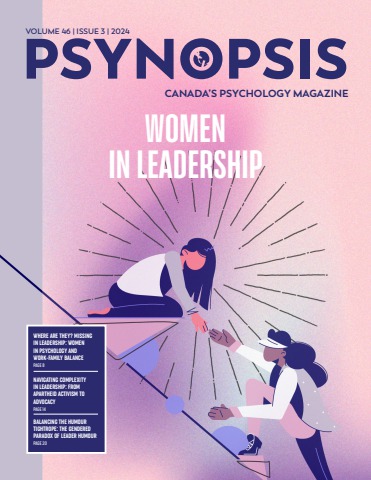

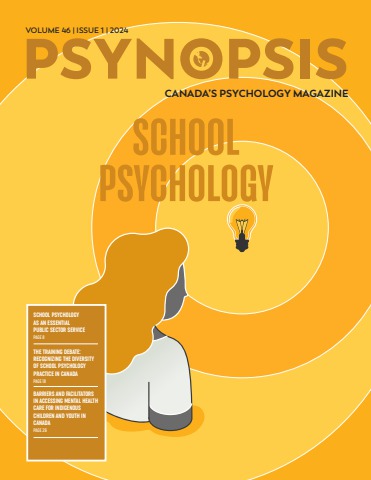


 Issue 3 2021
(PDF & References)
Issue 3 2021
(PDF & References)


 Issue 2 2020
(
Issue 2 2020
( Issue 1 2020
(PDF & References)
Issue 1 2020
(PDF & References)
 Issue 4 2019
(PDF & References)
Issue 4 2019
(PDF & References)
 Issue 3 2019
(PDF & References)
Issue 3 2019
(PDF & References)
 Issue 2 2019
(
Issue 2 2019
( Issue 1 2019
(
Issue 1 2019
( Issue 4 2018
(
Issue 4 2018
( Issue 3 2018
(
Issue 3 2018
( Issue 2 2018
(
Issue 2 2018
( Issue 1 2018
(
Issue 1 2018
( Fall 2017
(
Fall 2017
( Summer 2017
(
Summer 2017
( Spring 2017
(
Spring 2017
( Winter 2017
(
Winter 2017
( Fall 2016
(
Fall 2016
( Summer 2016
(
Summer 2016
( Spring 2016
(
Spring 2016
( Winter 2016
(
Winter 2016
( Fall 2015
(
Fall 2015
( Summer 2015
(
Summer 2015
( Spring 2015
(
Spring 2015
( Winter 2015
(
Winter 2015
( Fall 2014
(
Fall 2014
( Summer 2014
(
Summer 2014
( Spring 2014
(
Spring 2014
( Winter 2014
(
Winter 2014
(