
New Content Alerts
Not a CPA Member? Sign up to receive a notification when new issues are available online.
| Invitation to Authors: Psynopsis Special Issue on Behavioural Addictions |
|---|
This special issue of Psynopsis, the flagship magazine of the Canadian Psychological Association, invites short, accessible contributions on behavioural addictions, with a particular emphasis on sports gambling, video gaming, and related emerging forms of digital and technology‑mediated addictions. The goal is to highlight how psychological science and practice are helping to understand, prevent, and treat these behaviours in Canadian contexts, and to explore their broader implications for individuals, families, communities, and policy.
Submissions may focus on empirical research, clinical practice, education and training, program or service development, or public policy and advocacy, but must clearly explain why the topic matters and what it means for Canadian psychology. Articles could, for example, address: risk and protective factors for sports betting or gaming problems; assessment and diagnosis of behavioural addictions; clinical or community‑based interventions (including digital or brief interventions); prevention and harm‑reduction strategies (e.g., in schools, universities, or sport settings); intersections with youth development, mental health, or social isolation; and the impacts of regulation, advertising, and technology design on behaviour. Integrative or reflective pieces on emerging issues (e.g., loot boxes, fantasy sports, esports, social casino games, or the blurring of gaming and gambling) are also welcome, provided they are grounded in psychological evidence.
Articles should be concise, engaging, and free of heavy jargon. They are not full research papers; rather, they should tell a clear story about a key issue, program, study, or perspective on behavioural addictions, highlighting what has been learned and what implications follow for practice, policy, or future research. The intended readership includes psychologists and students across subdisciplines, policymakers, and practitioners who may not specialize in addiction.
Article format and length
|
Psynopsis
2025
 Issue 3 2025
(PDF & References)
Vol. 47, No. 3
NEW
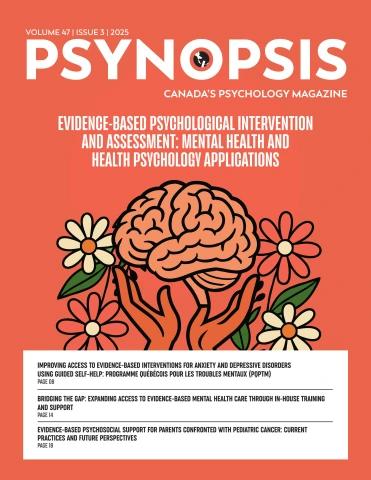
Evidence-based Psychological Intervention And Assessment: Mental Health and Health Psychology Applications
Issue 3 2025
(PDF & References)
Vol. 47, No. 3
NEW
Evidence-based Psychological Intervention And Assessment: Mental Health and Health Psychology Applications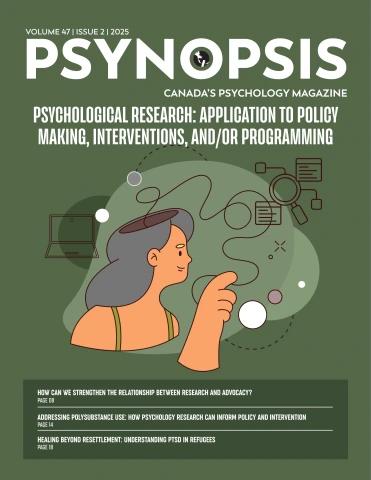 Issue 2 2025
(PDF & References)
Vol. 47, No. 2
Psychological Research: Application to Policy Making, Interventions, and/or Programming
Issue 2 2025
(PDF & References)
Vol. 47, No. 2
Psychological Research: Application to Policy Making, Interventions, and/or Programming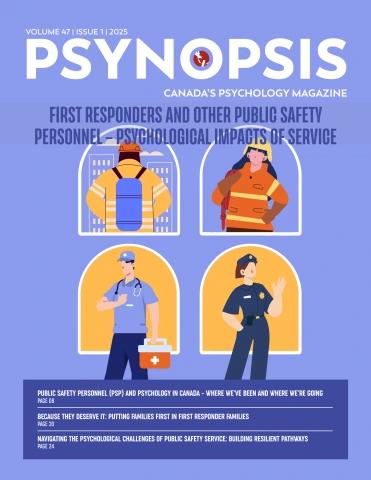 Issue 1 2025
(PDF & References)
Vol. 47, No. 1
First Responders and Other Public Safety Personnel – Psychological impacts of Service
Issue 1 2025
(PDF & References)
Vol. 47, No. 1
First Responders and Other Public Safety Personnel – Psychological impacts of Service2024
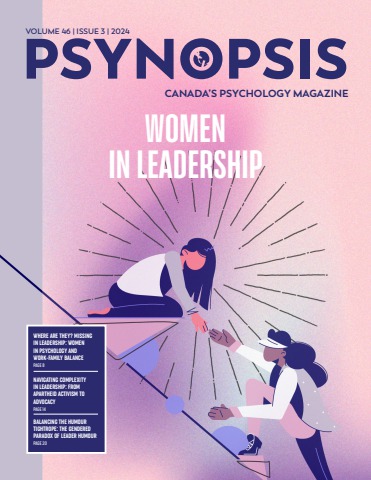

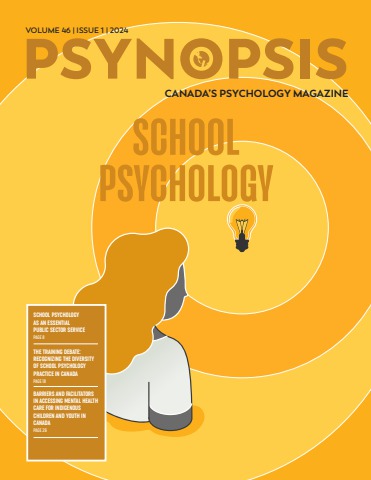
2023


2022


2021

 Issue 3 2021
(PDF & References)
Vol. 43, No. 3
Education, Schools, and Schooling: Looking to the Future
Issue 3 2021
(PDF & References)
Vol. 43, No. 3
Education, Schools, and Schooling: Looking to the Future

2020


 Issue 2 2020
(
Issue 2 2020
( Issue 1 2020
(PDF & References)
Vol. 42, No. 1
The role of Psychologists in autism-related policy and practice in Canada
Issue 1 2020
(PDF & References)
Vol. 42, No. 1
The role of Psychologists in autism-related policy and practice in Canada2019
 Issue 4 2019
(PDF & References)
Vol. 41, No. 4
What is needed and what is next for Canada’s research community?
Issue 4 2019
(PDF & References)
Vol. 41, No. 4
What is needed and what is next for Canada’s research community? Issue 3 2019
(PDF & References)
Vol. 41, No. 3
Indigenous Peoples mental health and wellbeing: Updates in Canadian psychology practice
Issue 3 2019
(PDF & References)
Vol. 41, No. 3
Indigenous Peoples mental health and wellbeing: Updates in Canadian psychology practice Issue 2 2019
(
Issue 2 2019
( Issue 1 2019
(
Issue 1 2019
(2018
 Issue 4 2018
(
Issue 4 2018
( Issue 3 2018
(
Issue 3 2018
( Issue 2 2018
(PDF)Vol. 40, No. 2
The role of psychology in mitigating Canada’s opioid crisis
Issue 2 2018
(PDF)Vol. 40, No. 2
The role of psychology in mitigating Canada’s opioid crisis Issue 1 2018
(
Issue 1 2018
(2017
 Fall 2017
(
Fall 2017
( Summer 2017
(
Summer 2017
( Spring 2017
(
Spring 2017
( Winter 2017
(
Winter 2017
(2016
 Fall 2016
(
Fall 2016
( Summer 2016
(PDF)Vol. 38, No. 3
National convention and much more – The value of the CPA
Summer 2016
(PDF)Vol. 38, No. 3
National convention and much more – The value of the CPA Spring 2016
(
Spring 2016
( Winter 2016
(
Winter 2016
(2015
 Fall 2015
(
Fall 2015
( Summer 2015
(
Summer 2015
( Spring 2015
(
Spring 2015
( Winter 2015
(
Winter 2015
(2014
 Fall 2014
(
Fall 2014
( Summer 2014
(
Summer 2014
( Spring 2014
(
Spring 2014
( Winter 2014
(
Winter 2014
(|
2013 Fall 2013 (PDF & References) – Vol. 35, No. 4 Summer 2013 (PDF & References) – Vol. 35, No. 3 Spring 2013 (PDF & References) – Vol. 35, No. 2 Winter 2013 (PDF & References) – Vol. 35, No. 1 |
2012 Fall 2012 (PDF & References) – Vol. 34, No. 4 Summer 2012 (PDF) – Vol. 34, No. 3 Spring 2012 (PDF) – Vol. 34, No. 2 Winter 2012 (PDF) – Vol. 34, No. 1 |
|
2011 Fall 2011 (PDF) – Vol. 33, No. 4 Summer 2011 (PDF) – Vol. 33, No. 3 Spring 2011 (PDF) – Vol. 33, No. 2 Winter 2011 (PDF) – Vol. 33, No. 1 |
2010 Fall 2010 (PDF) – Vol. 32, No. 4 Summer 2010 (PDF) – Vol. 32, No. 3 Spring 2010 (PDF) – Vol. 32, No. 2 Winter 2010 (PDF) – Vol. 32, No. 1 |
|
2009 Fall 2009 (PDF) – Vol. 31, No. 4 Summer 2009 (PDF) – Vol. 31, No. 3 Spring 2009 (PDF) – Vol. 31, No. 2 Winter 2009 (PDF) – Vol. 31, No. 1 |
2008 Fall 2008 (PDF) – Vol. 30, No. 4 Summer 2008 (PDF) – Vol. 30, No. 3 Spring 2008 (PDF) – Vol. 30, No. 2 Winter 2008 (PDF) – Vol. 30, No. 1 |